
Guide
How to write a cover letter
A clear, six-step method with examples of strong and weak lines, a complete sample, and a builder that walks you through each paragraph.
Before you write: three things to find
A cover letter written before you understand the job reads like a form letter. Spend ten minutes on these first:
- The job description. Underline the three to five requirements that appear first or most often. These are what the reader is screening for.
- The reader. Look for the hiring manager's or recruiter's name on the post, the company site or LinkedIn. For schools it is usually the Principal.
- One reason for this company. A product you use, a project they announced, their reputation for training, the city or the sector. One honest reason is enough.
Step 1: Set up the header
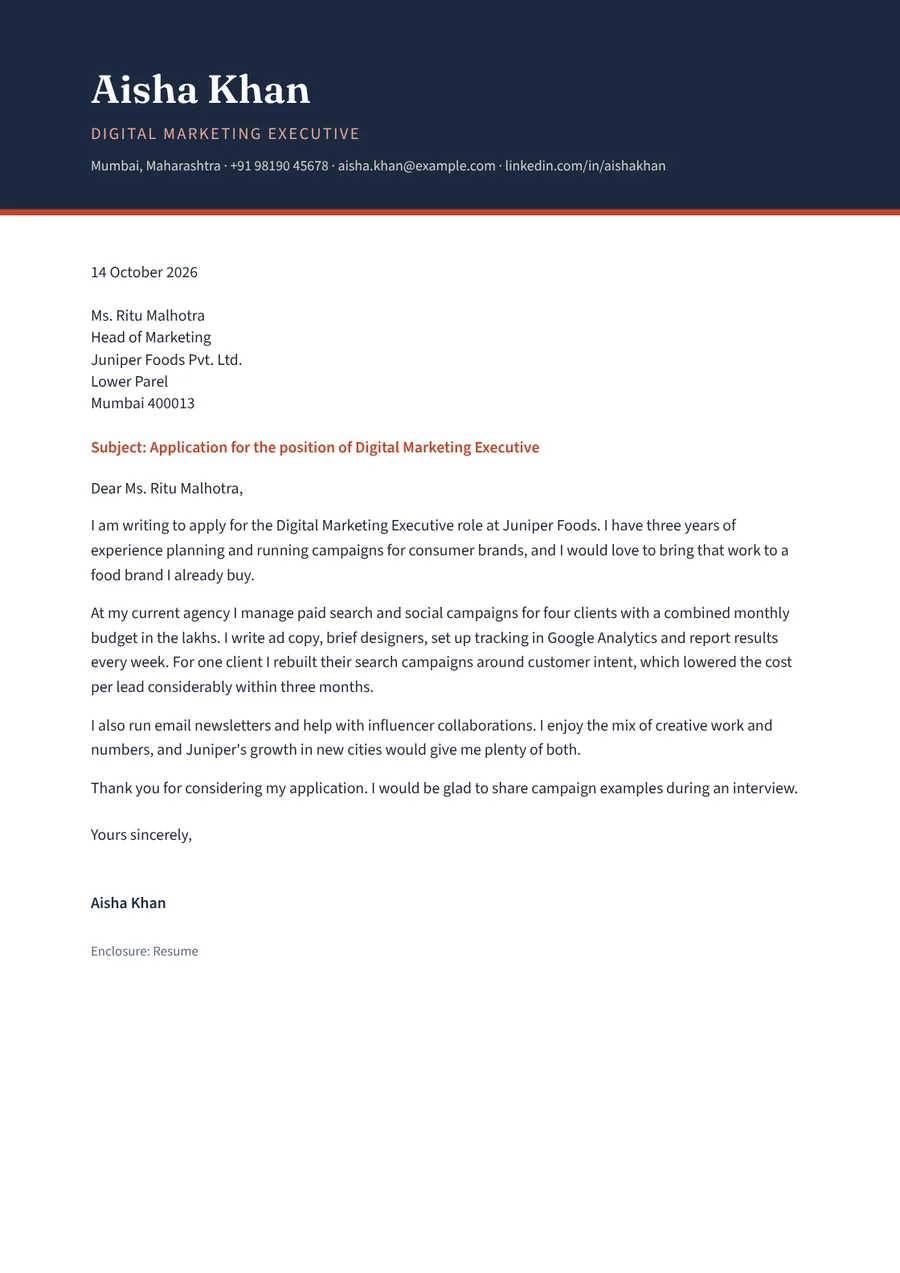
At the top go your name, phone, email, city and LinkedIn or portfolio. Then the date, then the employer's details (name, title, company, address). In India it is common to add a subject line such as Subject: Application for the post of Accounts Executive. It is optional elsewhere, but it never hurts.
Step 2: Write an opening that earns the next line
Your first two sentences decide whether the rest is read. Say what you are applying for, where you saw it, and the single most relevant fact about you. Avoid opening with your name ('My name is...'): it is already at the top.
For freshers: 'I recently completed my B.Com from Delhi University and would like to apply for the Accounts Trainee position at...' For career changers: say you are switching deliberately and how you prepared.
Step 3: Show why you fit, with evidence
Take the requirements you underlined and answer two or three of them. For each one, give a short example: the situation, what you did and the result. Numbers help, but only use numbers you can explain in the interview.
| Job asks for | Weak line | Strong line |
|---|---|---|
| Excel skills | I am good at Excel. | I prepare our weekly sales report in Excel using pivot tables and VLOOKUP for 40 outlets. |
| Team player | I am a team player. | I trained three new joiners on our refund process and wrote a one-page guide the team still uses. |
| Attention to detail | I am detail oriented. | Our last two statutory audits closed without major observations on the ledgers I maintain. |
Step 4: Add proof and a reason for this company
The third paragraph is where most letters fall flat. Give one result you are proud of, then one specific reason you want this employer. 'I admire your company' is not a reason; 'your stores in tier 2 cities are exactly the market I have worked in' is.
Step 5: Close and ask for the interview
Thank the reader, mention that your resume is attached, and ask for a conversation. Then the sign-off: Yours sincerely when you know the reader's name, Yours faithfully (British and Indian formal usage) when you wrote 'Dear Sir/Madam', or Kind regards for email. Leave space for a signature on printed letters, then your typed name.
Step 6: Check it like an editor
- Is the company name and job title spelled exactly as in the advertisement?
- Does every paragraph answer 'why should we interview this person?'
- Is it under one page and under about 400 words?
- Did you remove every sentence that would be true of any applicant?
- Did you read it aloud once? Clumsy sentences become obvious.
- Is the file named sensibly, such as Priya-Sharma-Cover-Letter.pdf?
A complete example
Frequently asked questions
How do I start a cover letter?
Start with the role you are applying for, where you saw it and one line about your most relevant experience or qualification. Skip 'My name is' and 'I am writing this letter to'.
How do I end a cover letter?
Thank the reader, say your resume is attached, and ask for an interview. Then a sign-off such as 'Yours sincerely' and your name.
Can I use ChatGPT to write my cover letter?
You can use an AI tool for a first draft, but edit it heavily. Generated letters tend to be generic and use the same phrases, which recruiters now recognise. Your own specific examples are what make a letter work.
Do I need a different cover letter for every job?
Change at least the opening, the company name, the role and one example for each application. Keep a strong base version to save time.
Should I mention salary in a cover letter?
Only if the advertisement asks you to. Otherwise leave salary for the interview or the HR discussion.